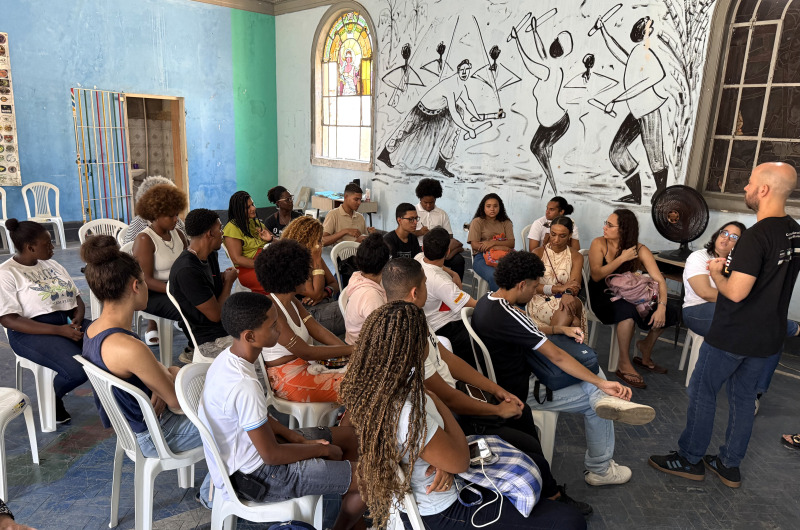
Selected by FAFERJ, the participants represent communities such as Morro da Coroa, Morro Dourado, Vila Progresso, Bangu, Cesar Maia, Magé, Vigário Geral, Vila da Penha, Jardim América, Irajá, Costa Barros, Freguesia, Santo Cristo, Inhoaíba, Vicente de Carvalho, Cordovil, and Sepetiba — a powerful portrait of the diversity and strength of Rio de Janeiro’s outskirts.
The course, led by Professor Pedro Dannemann, is part of the renowned training program created and implemented by the Latin American Training Center (LATC), with support from the Culture Council of the Commercial Association of Rio de Janeiro (ACRJ). Over six weeks, students immerse themselves in the audiovisual world, learning to develop scripts, films, and to produce short films using mobile phones — an accessible approach that democratizes access to cinematic language.
More than technical training, the project offers something even more valuable: a voice. Each participant is encouraged to tell their own story, reflecting their experiences, challenges, and perspectives in a process that strengthens identity, self-esteem, and protagonism.
In addition, the course acts as a bridge to the audiovisual market, connecting young people with production companies and experienced professionals, opening concrete pathways for professional insertion in one of the most dynamic sectors of the creative economy.
According to Steve Solot, President of LATC: “The project is a tool to provide young people in vulnerable situations with access to opportunities and resources that allow them to develop their potential and actively participate in society.”
For Rossino de Castro Diniz, President of FAFERJ: “This project is a great opportunity for the favela associations represented by FAFERJ to connect with youth and transform lives through participation in a recognized and transformative audiovisual course.”
Sergio Costa e Silva, President of the Culture Council of ACRJ, adds: “’Making My First Film’ demonstrates in practice how audiovisual media can be a powerful tool for inclusion, training, and social development, connecting talent from communities with real opportunities in the creative market.”
About the project:
“Making My First Film” is an initiative of the Culture Council of ACRJ that has been establishing itself as a benchmark in social inclusion through audiovisual media. The project includes collaboration with institutional, strategic, and private partners, including ABC Cursos de Cinema, Atrevida Filmes, VIVA Productions, Paula Tupinambá Advocacia, SICAV, and ALM Insurance. In 2025, the project implemented six courses, for 85 underprivileged youths, who produced 45 short films in more than 25 favelas and municipalities in the State of Rio de Janeiro. The initiative is further strengthened by the support of the newly created Strategic Advisory Council composed of public and private sector personalities committed to the project’s expansion and sustainability.
About FAFERJ:
Founded on July 6, 1963, FAFERJ is a non-profit, public-interest organization with over 60 years of activity. Representing communities throughout the State of Rio de Janeiro, the institution works to defend the rights of favela residents and promotes actions focused on citizenship, inclusion, and social development.
https://www.faferj.org/
About LATC:
The Latin American Training Center (LATC), based in Rio de Janeiro offers professional training, consulting, and the development of initiatives for the audiovisual industry, including social inclusion projects alongside technical training programs for audiovisual professionals across Latin America.
https://latamtrainingcenter.com/?lang=pt-br
Contact: steve.latc@gmail.com